
The Slowest Part of a Blood Test Isn't the Test
An analyser counts a blood sample in about a minute. The retyping, phone calls and WhatsApp photos that follow can take the rest of the day. Here is how Labgen connects the lab, the patient and the doctor.
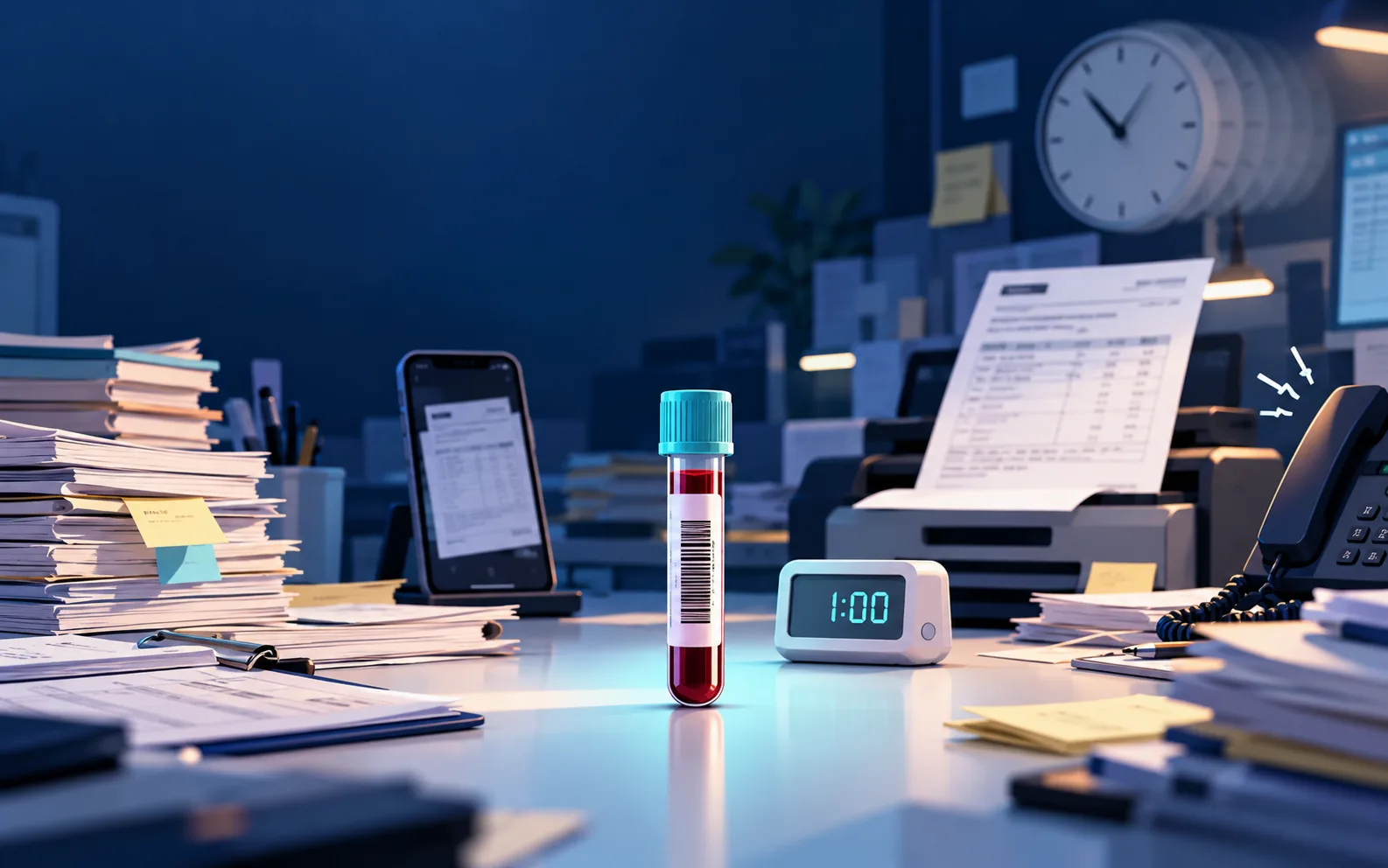
Ask a lab owner which part of a blood test takes the longest, and you might expect them to name the analyser.
It isn't the analyser. A modern haematology analyser counts the cells in a blood sample in about a minute. The slow part is everything that happens around that minute.
The result is copied into a register. Someone retypes it into the software. The report is printed, signed, scanned and photographed. The photo goes out on WhatsApp, sometimes to the wrong number. The referring doctor calls to ask whether it's ready. The patient calls to ask what "Haemoglobin 10.8 L" means. A day goes by, and nobody is any healthier for it.
The test was never the slow part. The process was.
Labgen exists to fix that process. We are building one connected system for the lab, the patient and the doctor, so that the people involved spend their time on diagnosis and treatment, not on paperwork.
One idea we hold ourselves to
Every feature we build has to pass one test:
The lab, the patient and the doctor should all be looking at the same report as soon as it's ready, and nobody else should be.
That is the whole idea. Labgen began with a wish to make diagnostics more organised and structured, so the effort goes into finding the problem and treating it, not into wrestling with the process. Everything below follows from that.
Follow one sample
Promises are easy to make, so here is a concrete example. Picture Meena, 52, walking into a neighbourhood lab that runs on Labgen, with a prescription for a complete blood count.
- At the front desk, she is registered once. Her tube gets a barcode label, so it can't be mixed up with the tube beside it.
- At the analyser, the result goes straight into Labgen through the machine interface. Nobody copies or retypes it, so there is nothing to mistype.
- On screen, every value is checked against the reference range for a 52-year-old woman. Her haemoglobin is flagged low before anyone has to go looking for it.
- Two people sign off. A technician verifies the result, then the pathologist authorises it. Meena can't see anything until the lab releases it, so an unchecked number never reaches a patient.
- When the report is released, Meena gets an SMS with a link to the Labgen patient portal. She opens her report on her phone and taps Explain in simple words. Instead of a line that reads "Hb 10.8 g/dL L", she gets a plain-language explanation of what her flagged values mean.
- Her doctor, who referred her, opens the same report in the Labgen doctor portal. No calls, no forwarded photos.
Nobody had to chase anybody. That is what we mean when we say reporting should be a breeze.
Shared with the right people, and only them
Sharing a report quickly should not mean losing control of it. So every route a report travels is closed to everyone who shouldn't be on it.
- Patients see only their own reports, and only after the lab has released them.
- Doctors see only the patients whose referrals a lab has linked to them, across every lab they work with.
- Every report has its own QR code and a private link that can't be guessed. When a lab shares a report on WhatsApp, Labgen sends that link, not a photo of a printout.
- The report is the same everywhere. What the lab prints, what the patient downloads and what the QR code opens are one and the same document. There is no second copy to fall out of date.
Because reports live in the cloud, a patient's history stays in one place: every visit and every report, on any phone, without a folder of paper. Patients can even upload a PDF from another lab and get the same plain-language explanation.
Trust you can check
Healthcare runs on trust, and trust should be something you can check, not something you are asked to take on faith. So we built the checks into the system.
- Verified labs. Every lab on Labgen is approved by our team before it goes live. Labs submit identity proof for the owner or pathologist responsible, along with the lab's letterhead, for review.
- Doctors connected through the labs that know them. A doctor sees a patient only when a lab they already work with has linked that referral to them.
- Checks at every step. Results come straight from the analyser. Every value is compared with the right reference range for the patient's age and gender, abnormal and critical values are flagged, and every report needs two sign-offs.
- A record of every change. If a result is amended after it has been authorised, Labgen records who changed what, and when.
Don't take our word for it. Scan the QR code on any Labgen report. It opens the report the lab authorised, not a copy someone retyped.
Your lab, your design
Labs differ, and they should. A lab that has built its name over twenty years doesn't want its reports to look like everyone else's. So Labgen doesn't decide what your report looks like. You do.
- Design your report templates by placing the blocks you want: patient details, result tables, signatories, notes.
- Your letterhead and footer go on every report automatically. NABL-accredited labs can show their accreditation logos beside the signatures.
- Set your own prices, your own reference ranges, and the test names and units you prefer. Design your own invoice, too.
We provide the structure underneath: validation, sign-off and the audit trail. What sits on top of it is yours.
Even the supply cupboard is connected
A lab that runs out of reagents stops working, however good its software is. So the ecosystem includes suppliers too.
In Labgen, a lab adds the suppliers it already works with, along with their phone number and email. When stock runs low, the lab places an order from the Lab Supply page and picks the supplier to send it to. The supplier receives the order straight away by email and SMS. No phone calls, no lost handwritten lists, and an order history the lab can look back on.
Why this matters
Behind every sample is someone who is worried. Meena isn't thinking about barcodes or reference ranges. She wants to know whether she is all right, and she wants her doctor to know too.
Most people who run a lab got into this work to help people like her, not to spend their days retyping results and returning phone calls. Every hour the process gives back is an hour that can go back to the patient.
That is the ecosystem we are building: verified labs, connected doctors, informed patients and responsive suppliers, all working from the same trusted record. Communication is faster, there are fewer errors, and every lab still has room to do things its own way.
The test was never the slow part. With Labgen, the rest of it doesn't have to be either.
Want to see how it fits your lab? Read the guides or see the plans.