From Dials to the Cloud: How Lab Machines Learned to Talk, and What Comes Next
Lab analysers went from brass counters with a needle dial to robots that talk to the cloud. Here is how machine interfacing grew up, which new analysers are arriving in 2025 and 2026, and what that means for a lab in India.
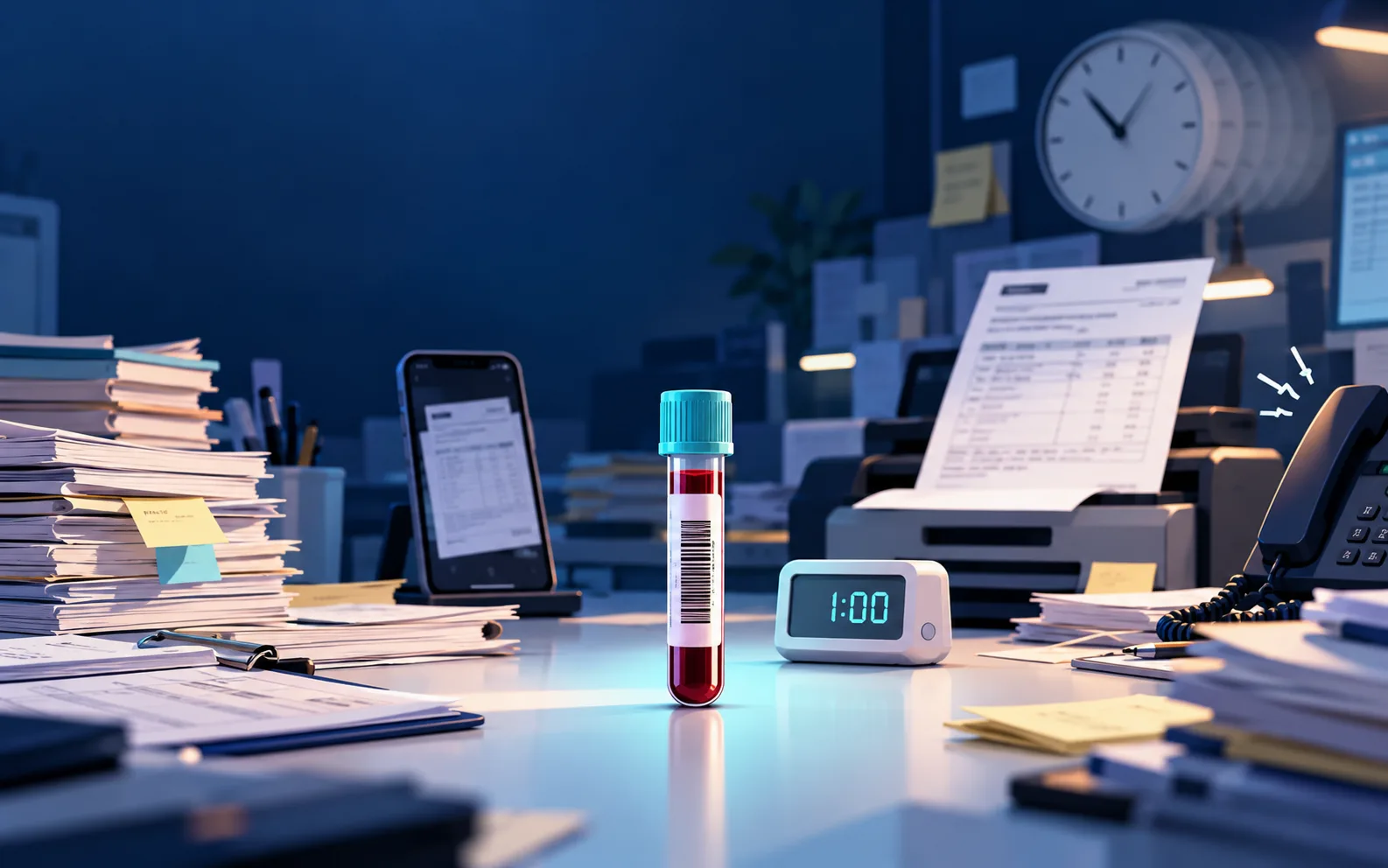
Every blood report starts with a machine. Somewhere a tube was loaded into an analyser, and a few minutes later it produced a list of numbers. What happens to those numbers next decides how fast and how safely the patient gets the report: are they retyped, printed or sent straight on?
That handover between the machine and the lab's software is called machine interfacing. It is easy to overlook, but it has shaped lab work for seventy years. This article traces how lab machines learned to talk, looks at the new analysers arriving now, and asks what the lab bench of the next few years will look like.
At a glance
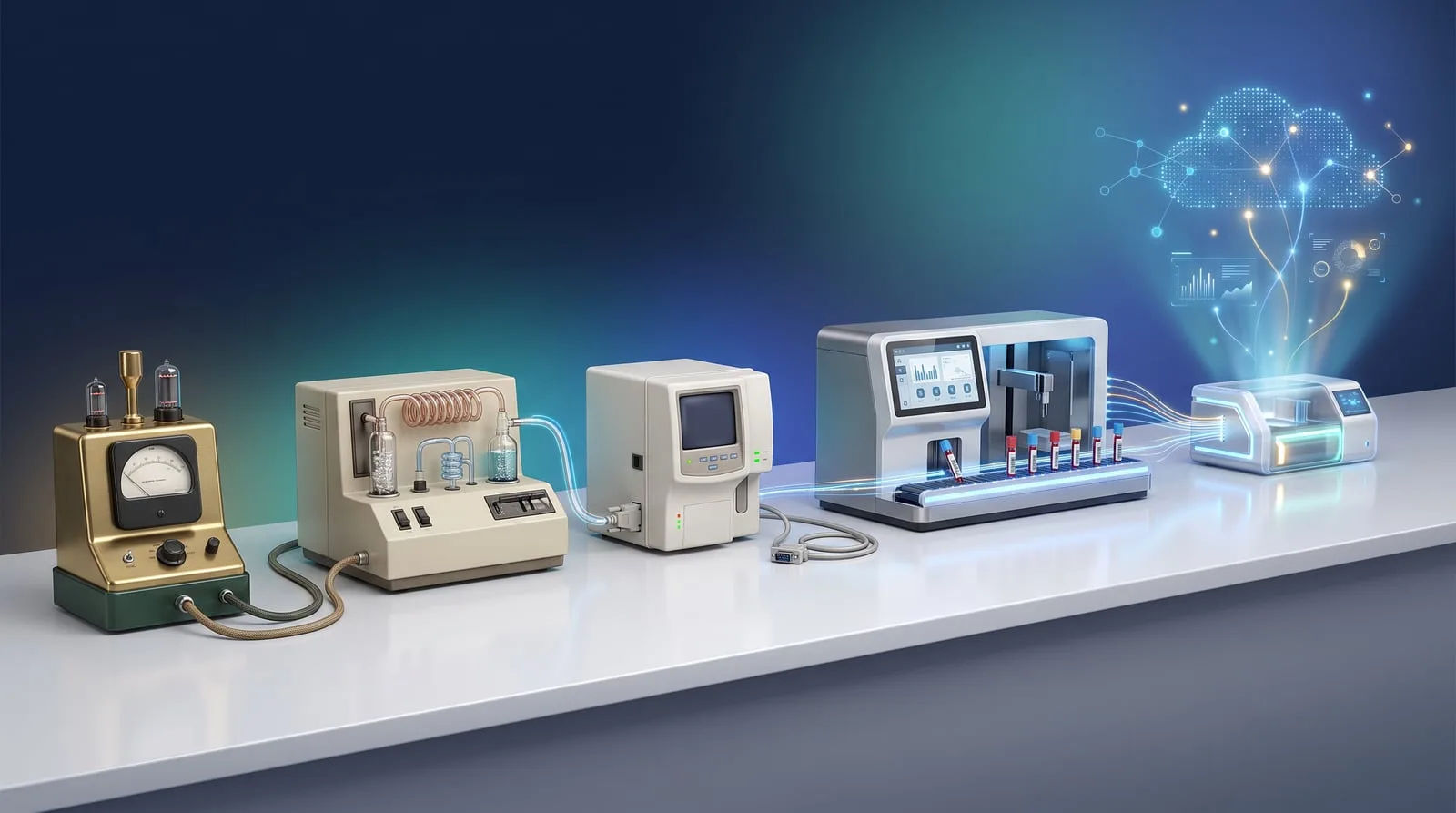
| Era | The machine | How results left it |
|---|---|---|
| 1950s | Coulter counter, a single-purpose cell counter | A needle on a dial, written down by hand |
| 1957 to 1970s | Technicon AutoAnalyzer and its successors | Chart recorders and paper printouts |
| 1980s to 2000s | Computerised chemistry and haematology analysers | A serial (RS-232) cable to one lab computer, using the ASTM standards |
| 2000s to 2010s | Networked analysers and middleware | HL7 messages over the lab network, often through a middleware box |
| 2020s | Automation lines, AI-assisted microscopy, cloud software | Encrypted links to cloud software, available on any screen in the lab |
1. The first machines could count, but couldn't talk
In the late 1940s Wallace Coulter worked out that a blood cell passing through a tiny opening briefly changes the electrical resistance across it. Count the blips and you have counted the cells. His patent was granted in 1953, and the Coulter principle still sits inside almost every haematology analyser sold today. When your analyser reports a WBC count, it is very likely counting cells the way Coulter did.
Chemistry followed in 1957, when Technicon launched the AutoAnalyzer, Leonard Skeggs' continuous-flow machine. Samples moved through coiled glass tubing separated by air bubbles, mixed with reagents along the way. Later models ran whole panels at once, and by 1974 the SMAC had a computer built in.
These machines did the measuring, but a person still had to read the result and copy it out. Every copy was a chance for a mistake.
2. The serial cable and a common language
As analysers gained computers, labs wanted the results to go straight into their own systems. The trouble was that every maker had its own format.
The answer was a pair of standards from ASTM, later handed to CLSI: ASTM E1381 for the low-level link, and ASTM E1394 for the message. An E1394 message is built from simple records:
- H is the header, saying which machine is sending.
- P is the patient.
- O is the order, including the tube's sample ID.
- R is a result.
The records travelled over an RS-232 serial cable to one computer, with special characters to start and end each frame and a checksum to catch errors. It was slow and fragile, but it worked, and a great many analysers in Indian labs still speak it today.
Around the same time, hospitals adopted HL7 version 2, which arrived in the late 1980s. Newer analysers began sending HL7 messages over the lab's ordinary network instead of a cable. Many labs added middleware, a box between the analysers and the lab system that translated each machine's dialect and held results for review.
3. Machines that ask questions back
The next step was making the conversation run both ways. In a bidirectional (host query) setup, the analyser reads a tube's barcode and asks the lab system which tests that patient needs. The lab system replies, and the machine runs exactly those tests. Nobody has to key in the order at the analyser.
Standards caught up. CLSI's AUTO16 standard, published in 2019, describes a modern network interface based on HL7 v2.5.1 and the IHE Laboratory Analytical Workflow (LAW) profile. It is meant to replace the old serial-era rules. For bedside devices such as glucose meters and blood-gas analysers, the POCT1-A standard, published in 2001, did a similar job.
4. Where things stand today
Three trends define the current generation of lab machines.
Automation lines for mid-size labs
Track-based automation, where tubes ride a conveyor from decapping to the analyser and into storage, used to be only for very large labs. Now it is being scaled down.
- Beckman Coulter's DxA 5000 Fit (2021) is aimed at labs running roughly 2,000 to 5,000 tests a day.
- Siemens Healthineers' Atellica Integrated Automation (2024) builds sample handling, decapping and sealing into a compact analyser.
Digital microscopy with AI
The peripheral smear, long done by eye at a microscope, is going digital. These systems photograph the slide and use AI to pre-sort the cells. A haematologist still confirms every result.
- Scopio Labs scans the whole slide. Its fourth FDA clearance, in June 2025, added AI-suggested grading of red cells.
- CellaVision launched a bone marrow application in Europe in March 2026.
- Mindray's MC-80 brought AI pre-classification to morphology in 2021.
Machines that are watched from afar
Makers now monitor analysers remotely. Siemens, for example, uses remote monitoring to predict faults before they stop a run. Service is moving from "call the engineer when it breaks" to "the engineer calls you before it does".
5. New machines arriving now
These analysers launched or won approval in the last two years. Status is as reported by each maker or regulator at the time of writing.
| Machine | What it is | Status |
|---|---|---|
| Sysmex XR-Series | The successor to Sysmex's widely used XN haematology line | FDA-cleared 2025; US launch May 2026 |
| Siemens Atellica HEMA 580 | High-throughput haematology that works with Scopio for digital slide review | US launch July 2026 |
| Roche cobas c 703 | Chemistry module for the cobas pro, up to 2,000 tests an hour | FDA-cleared March 2026 |
| Roche cobas Mass Spec | Brings mass spectrometry into the routine lab as an automated analyser | CE-marked December 2024 |
| Beckman Coulter DxC 500i | Chemistry and immunoassay in one compact analyser | CE-marked 2024; FDA-cleared March 2025 |
| Mindray CAL 9000 | A haematology line that runs CBC, ESR and HbA1c from one tube | Shown at ADLM 2025 |
| Snibe MAGLUMI X10 | High-throughput immunoassay with a total lab automation option | Launched globally 2025 |
| Roche AXELIOS 1 | A new sequencing system (sequencing by expansion) for fast whole-genome work | Launched June 2026, research use only |
The pattern across this list is the same. Machines are doing more per tube, fitting into smaller spaces and expecting to be connected from day one.
6. What the lab bench looks like in the next few years
Every analyser is networked
Serial ports are disappearing from new machines. The standard is now a network port speaking HL7. A lab that still depends on one PC with a serial card will find each new analyser harder to connect.
The lab system moves to the cloud
When results flow to cloud software instead of one desktop, the report is available at every counter, every branch and on the pathologist's phone. The analyser no longer has to sit next to "the lab computer".
AI as a second pair of eyes
Expect more AI-assisted review: smears pre-sorted, delta checks against a patient's earlier results, and unusual result patterns flagged before sign-off. In 2026 the FDA also cleared AI tools for digital pathology, such as ArteraAI Breast. In each case the AI suggests and a qualified person decides.
Smaller machines, closer to the patient
Compact analysers are bringing full panels to smaller labs and clinics.
- Fingerstick blood counters, such as Sight Diagnostics' OLO, run a CBC from a drop of blood.
- Portable PCR, such as India's own Molbio Truenat (endorsed by the WHO in 2020), runs on a battery and gives a result in under an hour.
- Retail blood draws, such as BD's fingertip collection system, take sampling out of the lab altogether.
Connected health records
In India, the Ayushman Bharat Digital Mission lets a lab share reports into a patient's health record using the FHIR standard. NABL labs, meanwhile, have moved to ISO 15189:2022, which expects a clear trail from sample to signed report. Both reward labs whose results arrive electronically rather than retyped.
More machines made in India
Indian makers such as Erba Transasia and Agappe now build fully automated chemistry and haematology analysers here, often at prices that suit small and mid-size labs. More choice means more mixed fleets, and a lab system has to speak to all of them.
7. Where Labgen fits
All of this points the same way. Analysers will keep getting smarter, but a lab only feels the benefit if their results reach the patient's report without being retyped.
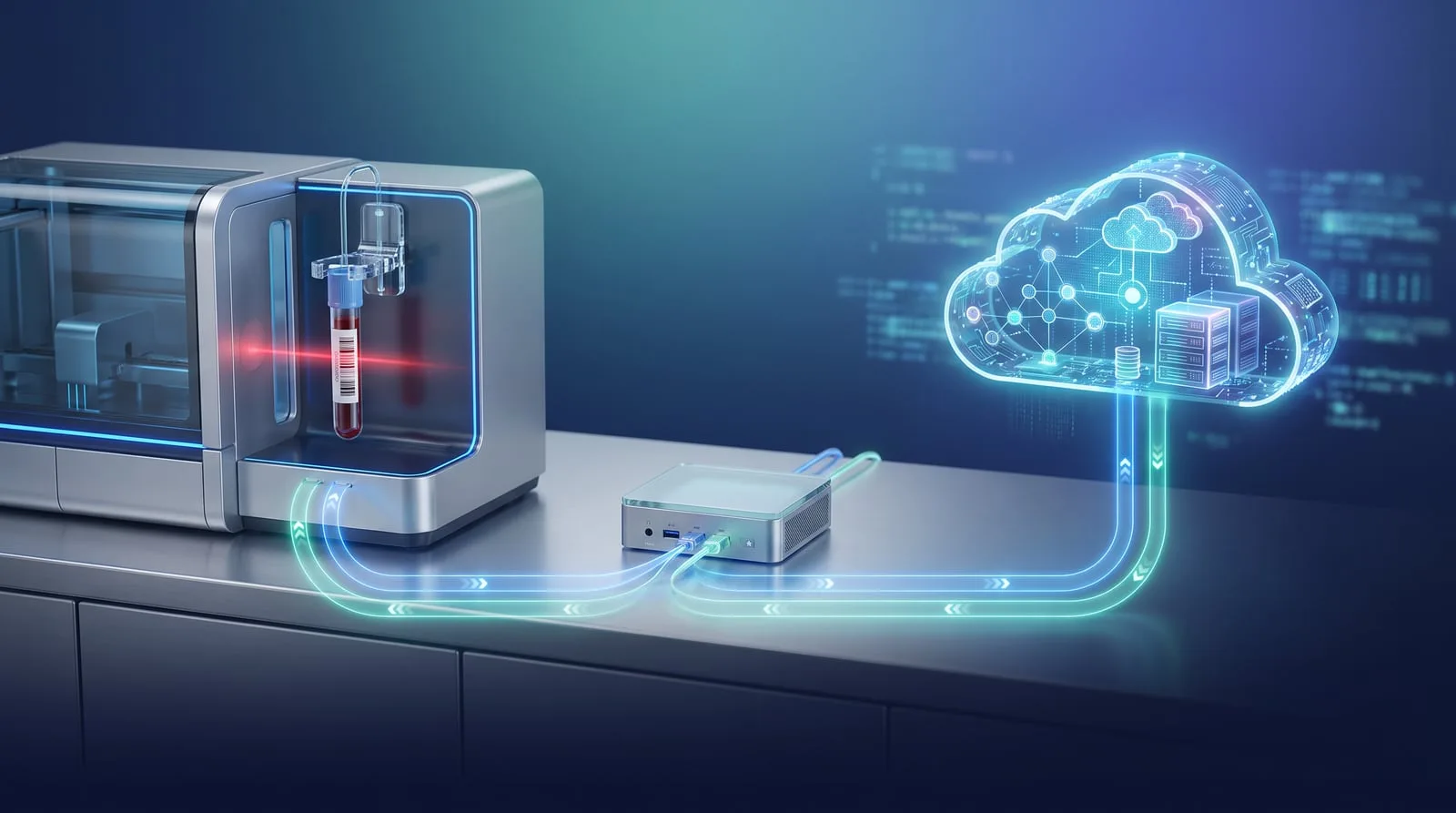
That is what Labgen's machine interfacing does. A small program called LabGen Bridge runs on the PC beside your analysers:
- It speaks both languages. It handles ASTM, over serial or network, and HL7, so a twenty-year-old analyser and a new one can sit side by side.
- It works whichever way the machine connects. It accepts analysers that call out to the PC, and it can also call out to analysers that wait to be connected, such as some Mindray models.
- Results find their own patient. They are matched by the tube's barcode, converted to your lab's units and filled into the right fields of the right test.
- Orders can go to the machine. Analysers that support host query can ask Labgen which tests a tube needs.
- Nothing gets lost. Anything that can't be matched waits under Unmatched Results, so it can be assigned rather than lost.
Analysers from Sysmex and Mindray already report live to Labgen this way, and the results arrive in the cloud, ready on any screen in the lab.
The short version
Lab machines went from a needle on a dial, to a cable to one computer, to a network, and now to the cloud. The machines arriving next will do more with less blood, in less space, with AI watching over the results. The labs that benefit most will be the ones whose software can take every result straight from the machine to the report.
Sources
- Drexel University: the Wallace H. Coulter story
- NCBI: history of the AutoAnalyzer
- CLSI: AUTO16, the next-generation instrument interface standard
- IHE: Laboratory Analytical Workflow profile
- Lab Manager: Sysmex XR-Series
- News-Medical: Atellica HEMA 580
- Roche: FDA clearance for cobas c 703
- Beckman Coulter: DxC 500i FDA clearance
- Roche: AXELIOS 1 launch
- Clinical Lab Products: Scopio Full Field PBS clearance
- ICMR: WHO endorsement of Truenat
- ABDM: guidelines for health information providers